
Journaling for Boundaries & How to Stop Over-explaining Yourself and Start Saying No
If you’ve ever sent a three-paragraph text apologising for something? Something you didn’t feel you’d even done wrong. Then come and sit with me for a minute—let’s talk about Journaling for Boundaries—as this one’s for you.
As an Amazon Associate, I earn from qualifying purchases. I only recommend products I genuinely believe will be useful to my readers.
You’re not alone in this, by the way. So many of us carry around this quiet, exhausting habit of over-explaining, over-apologising, and saying yes when every part of us is screaming no. It’s not a personal failing. It’s something we picked up early and practised for years.

Boundaries are one of the hardest things women are asked to build — mostly because we were never really taught how. We were taught to be agreeable, to smooth things over, to keep everyone else comfortable. Nobody handed us a script for “no, that doesn’t work for me.” So when we try to say it for the first time, it can feel clumsy, even a little scary — like we’re breaking a rule nobody wrote down but everybody enforced.
Here’s the good news: you don’t have to get it perfect, and you definitely don’t have to figure it out live, in the moment, with your heart pounding. That’s where journaling comes in.
Using journaling for boundaries won’t magically make boundary-setting any easier. Nothing really does — it’s a skill, and skills take practice. But journaling gives you something incredibly valuable: a private, low-pressure space to figure out what you actually want to say *before* you’re standing in front of the person you’re saying it to, words tangling and guilt creeping in.
Why Journaling Works for This
Boundary conversations go wrong in the moment for one simple reason: we’re trying to figure out our feelings *and* communicate them clearly at the same time, live, under pressure, usually with an audience of one very uncomfortable person. That’s a lot to ask of anyone. Journaling gently separates those two jobs. On the page, you get to feel messy and unfiltered — ramble, vent, contradict yourself, whatever you need — and only* afterwards do you shape it into something calm and clear you’d actually say out loud.

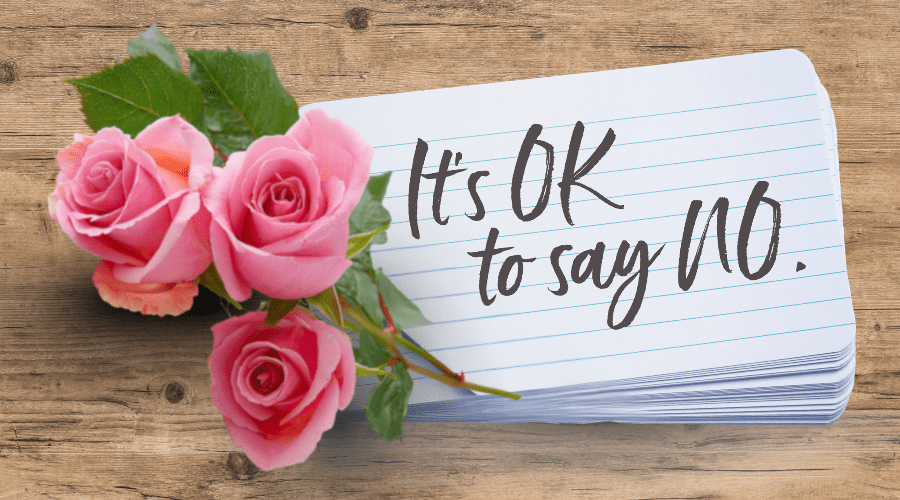
It’s hard to say no!
Journaling for boundaries also catches the guilt spiral before it catches you. So many of us feel guilty the second we even think about setting a boundary, long before we’ve said a word. Writing down “why do I feel guilty about this” tends to surface the real story underneath — usually something like I was taught that a good woman doesn’t inconvenience anyone. And once that belief is sitting there in your own handwriting, out in the open, it’s so much easier to look at it kindly and say, “okay, but is that actually true anymore?” — instead of letting it loop silently in your head, unchallenged, at 2 am.
Prompts to Get You Started
When you’re deciding whether to set a boundary
What am I saying yes to, and what am I actually giving up by saying it? – If a friend described this exact situation to me, what would I tell her to do? – What’s the worst realistic outcome of saying no here — and could I survive it?

When you’re drafting what to say when journaling for Boundaries
What’s the one-sentence version of what I need, with no apology attached? – Where am I over-explaining, and what happens if I cut it in half?
When it’s already happened, and you’re replaying it
What went well, even if it felt awkward? – What would I do differently next time — not to be harsher, just clearer?
A Small Practice to Try This Week when Journaling for Boundaries
Pick just one recurring situation where you tend to say yes when you mean no — a favour, a meeting, a family obligation, whatever comes to mind first. Before it comes up again, sit down with your journal and write out exactly what you’d say if guilt weren’t part of the equation at all. Keep it short and plain. Read it over a few times, maybe even say it out loud to an empty room.
You’re not memorising a script when practising journaling for boundaries, and you don’t need to sound like a different person. You’re just giving yourself a little practice run, so the words feel a bit less foreign in your own voice when the real moment comes.

And if it still feels shaky the first time you say it out loud for real? That’s completely normal. Be gentle with yourself about it. That’s really what boundary-setting comes down to, in the end — not perfect confidence, just making the unfamiliar a little more familiar, one page and one small brave moment at a time.
If you’re not sure how to start journaling, and if it’s for you. Then take a look at how to start a journal.
I found this little Video on YouTube that explains what Self-Compassion involves when journaling.
Please keep in touch – scan the QR to join our newsletter